When people speak about facilitation, they often refer to modern workshop methods, leadership frameworks, or organisational tools.
However, when facilitation is explored through a Māori lens, a different picture begins to emerge.
Many of the principles that guide facilitation today have long existed within Māori cultural practices.
One of the most powerful examples of this can be seen within the pōwhiri process on a marae.
Exploring Facilitation Through Tikanga Māori
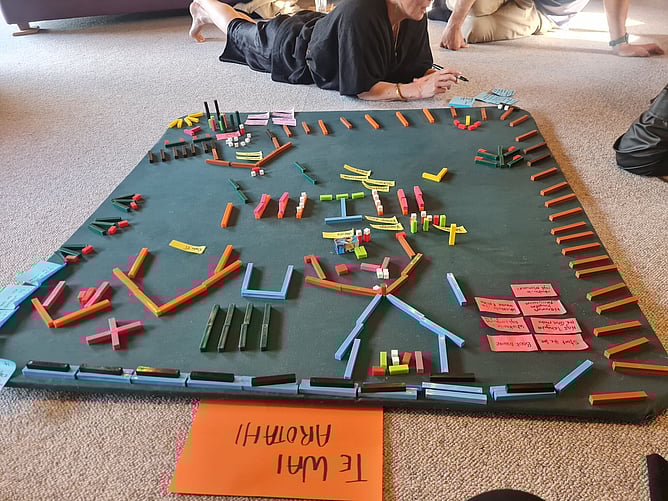
During a recent wānanga, a small group gathered over three days to explore what facilitation looks like when grounded in te ao Māori.
Under the guidance of experienced knowledge holders, the group began by setting aside familiar facilitation models and returning to tikanga as the starting point.
Together, the group mapped out the pōwhiri process, exploring the structure and purpose behind each stage.
This involved:
examining the layout of the marae and the sequence of the pōwhiri
understanding the purpose behind each step in the process
reflecting on what is being facilitated within each stage of the gathering
Through this exploration, it became clear that Māori processes are deeply intentional and inherently facilitative.
The Facilitation Within the Pōwhiri
The pōwhiri process guides groups through a carefully structured journey that moves participants from separation to connection and shared purpose.
From the moment the karanga begins, the spiritual dimension of the gathering is acknowledged and opened.
Within te ao Māori, the presence of atua and ancestral forces is recognised as part of the process that shapes the gathering.
As participants move through the stages of the pōwhiri, the process gradually brings diverse perspectives together in a shared space.
By the time the formal welcomes, speeches, and acknowledgements are complete, participants have moved through a carefully guided process that prepares them to engage with one another.
In essence, this is the heart of facilitation.
Creating the conditions for people with different perspectives to gather, connect, and work towards a common purpose.
Indigenous Knowledge and Facilitation Practice
For many Māori communities, these practices are so familiar that we rarely pause to reflect on how sophisticated they are.
Yet when viewed through the lens of facilitation, it becomes clear that tikanga Māori already contains deeply intentional processes for guiding dialogue, managing relationships, and creating shared understanding.
These processes have been practised for generations.
They hold wisdom about how people gather, how conversations unfold, and how collective decisions are made.
Standing Strong as Indigenous Facilitators
Exploring facilitation through tikanga Māori also reminds us that Indigenous communities have long held expertise in facilitating complex gatherings.
The challenge now is to bring this knowledge to the surface and recognise its value within contemporary facilitation practice.
When Māori facilitators stand confidently within these knowledge systems, they bring both cultural depth and practical insight to the spaces they hold.
A Karakia for Facilitation
At the conclusion of the wānanga, participants created a karakia that captures the essence of facilating through a Māori lens.
The words reflect the weaving together of people, purpose, and collective direction.
Te Wai o Arotahi
Rangaranga ngā whenu kia tuhonohono ai
Tuituia ōna mana ōna tapu kia tau
Tukua ngā here kia wātea
Turakina ngā taero kia rite
Tauawhia ngā tikanga kia kotahi e
Tohua tō ara rautaki ki Hawaiki Hou
Whaia tō koronga kia mau, kia ū
E arotahi ai tātou e i
Weave the threads that gather, binding them strong and true.
Let our strength and sacredness settle so balance may flow within.
Release what weighs us down and clear the path before us.
Uphold our tikanga so we may stand together as one.
Turn our gaze toward new beginnings.
Walk with purpose and move with heart.
Together we rise, aligned in one breath and one shared direction.
Through practices like these, the depth of Māori facilitation continues to unfold.
And with it, the opportunity to bring Indigenous wisdom into the spaces where communities, organisations, and futures are shaped.

