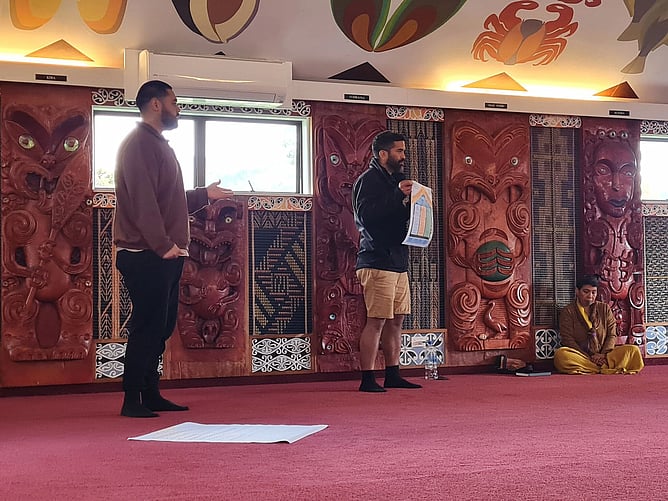
Strategic planning for marae and hapū often begins in places that conventional strategy processes do not.
Rather than starting with organisational structures or financial priorities, the work often begins with whakapapa, history, and connection to the whenua.
During a recent strategy wānanga with the whānau of Harataunga Marae in the Coromandel, this approach played a key role in shaping the collective vision for the marae.
Continuing the Strategy Journey
The wānanga was part of the second stage of Harataunga Marae’s strategic planning journey.
During the hui we worked together to:
present the strategy design developed during the first hui
explore the whakapapa connections to Rakairoa Marae
identify the unique characteristics that shape the marae’s identity
develop a five year action plan to guide the work ahead
As often happens in facilitation spaces, the process evolved in ways that were not originally planned.
Beginning With Whakapapa
One activity that proved particularly powerful was whakapapa mapping.
Instead of beginning with traditional introductions, participants were invited to map out their known whakapapa as far back as they could remember, connecting their lines of descent to a central ancestor associated with the marae.
Using coloured notes to represent both participants and ancestors, the wall quickly began to fill with connections.
As the whakapapa took shape, stories began to emerge. Participants shared memories, asked questions, and rediscovered connections within the wider whānau.
For some, the process was affirming. For others, it opened space for healing.
In every case, it deepened the sense of connection within the room.
Discovering the Vision Through Ancestral Qualities
During the whakapapa mapping activity, three prominent ancestors began to stand out in the kōrero:
Rakairoa
Materoa
Te Aowera
Recognising the significance of these ancestors, the group was invited to form three small groups, each representing one of the ancestral figures.
Each group explored the qualities that their ancestor embodied and how those qualities continue to influence the identity of the marae today.
From these discussions, each group crafted a short statement reflecting those qualities.
When the three statements were brought together, they naturally formed a collective vision statement for Harataunga Marae.
Rather than being imposed through a structured strategy exercise, the vision emerged organically from the whakapapa and stories shared by the group.
Strategy Grounded in Whakapapa
This experience highlights the value of Māori facilitation approaches in strategic planning.
When strategy is grounded in whakapapa, identity, and collective memory, the outcomes often carry deeper meaning for those involved.
However, activities like these can sometimes surface deep emotion or mamae. For facilitators, it is important to remain attuned to the wairua of the space and to guide the conversation carefully when these moments arise.
Each marae and each wānanga will produce different outcomes.
The role of the facilitator is not to control the process, but to recognise those moments when the kōrero reveals something significant and allow the group to follow that direction.
Strategy That Is Tipuna Inspired and Mokopuna Driven
For many Māori organisations and communities, strategy is not only about planning for the next few years.
It is about honouring the wisdom of those who came before while creating direction for the generations yet to come.
When strategy is shaped through whakapapa and collective participation, it becomes more than a document.
It becomes a shared vision for the future.

