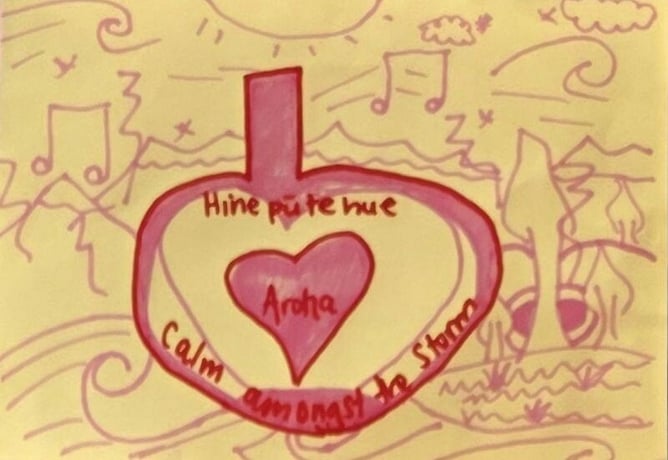
In te ao Māori, many of the principles that guide leadership, relationships, and collective decision making can be understood through pūrākau.
These stories hold insights that continue to shape how we think about our roles in community, in organisations, and in the spaces we hold for others.
For facilitation, one of the closest representations of process and presence can be found in Hinepūtehue.
The Story of Hinepūtehue
Hinepūtehue is the daughter of Tāne Mahuta.
In her physical form she is represented by the hue, a gourd that grows in many different shapes and forms.
Within pūrākau, she is associated with sound, vibration, and the creation of musical instruments made from gourds. Her presence reflects the transformation of energy into rhythm and expression.
Her story begins during a time of great upheaval.
When the children of Ranginui and Papatūānuku separated their parents, the world shifted into a new and unfamiliar state. Chaos and uncertainty followed as the natural order changed.
But Hinepūtehue did not add to the chaos.
Instead, she absorbed it.
Receiving the Storm
As a hue, Hinepūtehue grew quietly.
She hung from the vine, receiving the elements around her. The wind moved across her surface. Rain struck her skin. The warmth of the sun settled into her form.
She did not resist these forces or react against them. She simply received them.
In time, the hue was hollowed out. Its interior was cleared and made spacious.
From that empty space, something new emerged.
When breath moved through the hollow form, sound was created. The body of the hue became pūoro, transforming the energies it had received into music.
Not reaction.
Not force.
But vibration offered back to the world from a place of aroha.
Facilitation as Holding Space
For facilitators, the pūrākau of Hinepūtehue offers a powerful metaphor.
Facilitation is not always about directing the conversation or controlling outcomes.
Often it is about creating space.
Space where diverse perspectives can be expressed. Space where different energies can be received without judgement. Space where people can process ideas, emotions, and possibilities.
Like Hinepūtehue, the role of the facilitator is often to hold the storm without becoming the storm.
Finding Rhythm in Complexity
When groups come together to explore strategy, change, or complex decisions, the energy in the room can sometimes feel chaotic.
Different viewpoints emerge. Emotions surface. Conversations move in unexpected directions.
Rather than trying to force order too quickly, effective facilitation allows these energies to move and settle.
By holding the space with care and patience, the group can begin to find its own rhythm.
From that rhythm, new understanding can emerge.
A Guiding Presence in Facilitation
For those facilitating through a Māori lens, Hinepūtehue can serve as a powerful reminder of what the role of facilitation can be.
To listen deeply.
To receive without judgement.
To create spaciousness where ideas can breathe.
To return the collective energy of the group in a way that allows it to move forward.
Facilitation in this sense is not about imposing direction.
It is about helping the group transform complexity into clarity.
And sometimes that transformation begins simply by holding the space with aroha.