Within the facilitation sector there has recently been growing conversation around the idea of “connection before content”.
The concept suggests that before groups begin discussing strategy, priorities, or decisions, time should be spent building relationships and trust among participants.
For many Indigenous cultures, however, this idea is not new.
Connection has always been a non negotiable starting point.
The Role of Whakawhanaungatanga
Within te ao Māori, the process of building relationships and connections is known as whakawhanaungatanga.
While often translated simply as relationship building, the concept carries much deeper meaning.
The word itself can be broken down as follows:
Whaka refers to the act of facilitating or bringing something into being.
Whānau refers to family, relationships, and connections.
Ngā indicates plurality.
Tanga transforms the concept into a noun.
Together, whakawhanaungatanga can be understood as the process of facilitating meaningful relationships and connections.
In Māori contexts this process is not superficial. It involves spiritual, emotional, and relational elements that allow people to understand how they are connected to each other, to place, and to shared history.
Longstanding Practices of Connection
Māori communities have long used structured cultural practices to support whakawhanaungatanga.
Processes such as pepeha, mihimihi, and whaikōrero allow individuals to introduce themselves through their connections to whenua, ancestors, and community.
These practices help participants understand not only who is in the room, but how they relate to each other.
When this process is given space at the beginning of gatherings, it creates a foundation of trust that allows deeper conversations to take place later.
Connection as the Foundation for Strategy
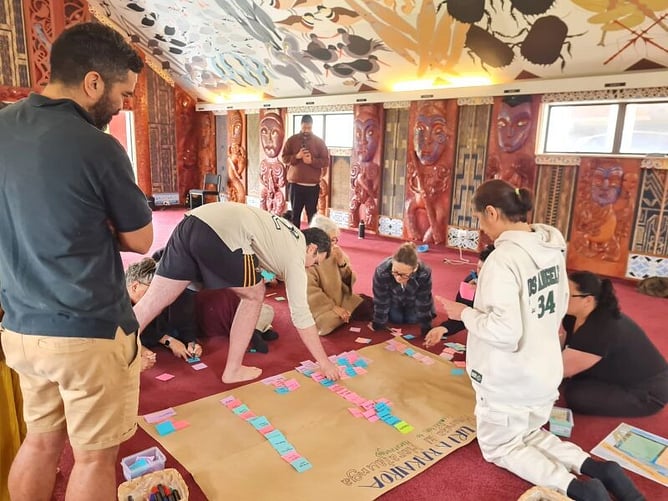
During one facilitation session with a hapū collective, whakawhanaungatanga took the form of an activity where participants mapped their whakapapa as far back as they could remember.
The purpose of the exercise was to:
help participants recognise connections within the wider hapū
acknowledge the ancestors who had shaped their collective identity
inspire participants to think about the future generations they were planning for
What began as a connection exercise quickly became something more.
As participants shared their whakapapa, the stories of three significant ancestors emerged. These ancestors had historically worked together to establish the foundations of the hapū.
Reflecting on their collaboration helped the group identify shared values and aspirations for the future.
From that conversation, the collective vision and mission statement for the group began to take shape.
This happened before the formal strategy discussions had even begun.
Indigenous Wisdom in Facilitation
Experiences like this remind us that Indigenous knowledge systems hold powerful insights for facilitation, leadership, and strategic planning.
When people understand how they are connected to each other and to the kaupapa they are working toward, conversations about the future become clearer and more meaningful.
Connection does not slow down the work.
In many cases, it enables it.
For facilitators and organisations alike, there is much to learn from Indigenous approaches that place relationships, identity, and collective purpose at the centre of the process.
These practices have been guiding communities for generations.